CBT-Informed Activities · CB-02
Thought Detective
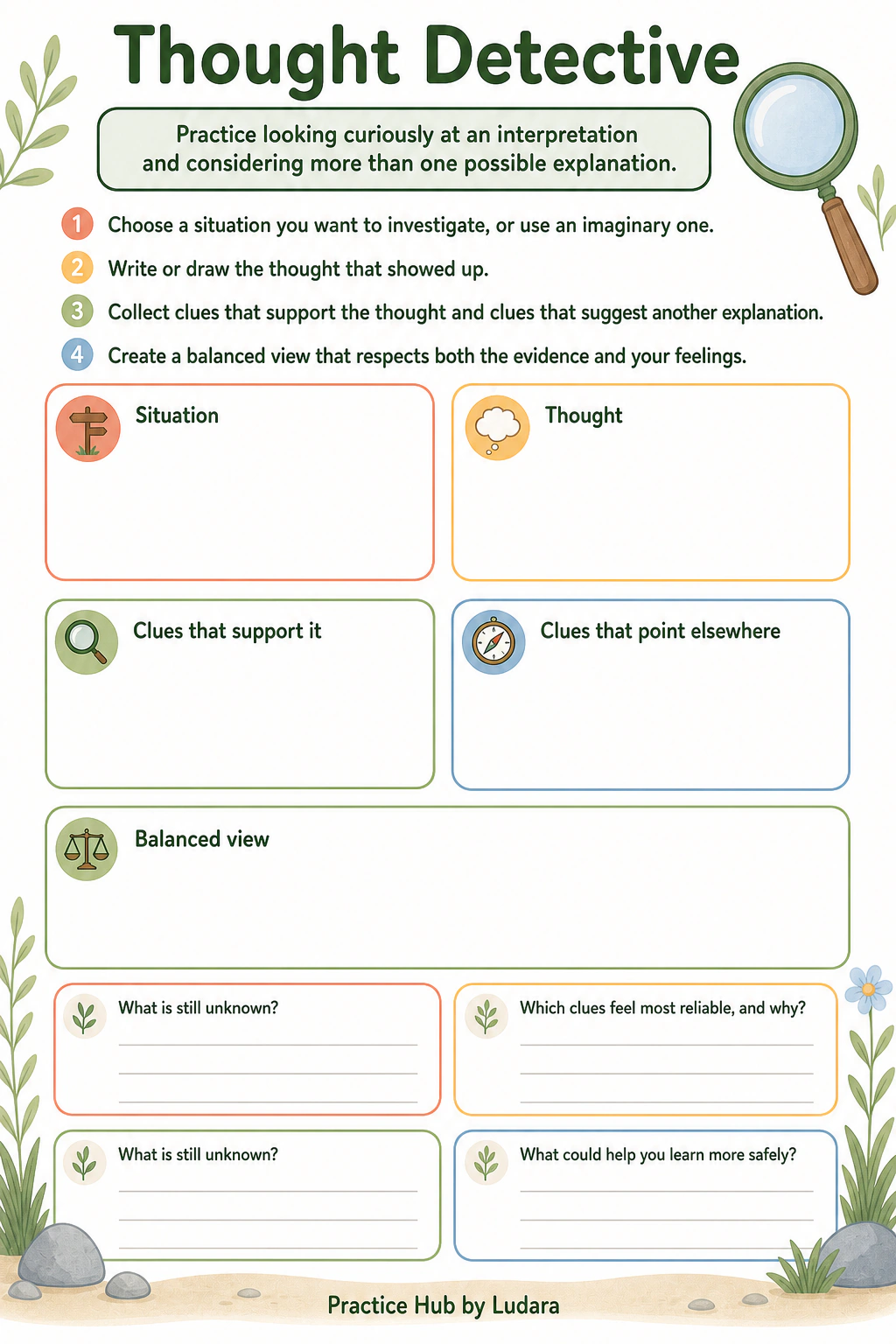
Practice looking curiously at an interpretation and considering more than one possible explanation.
Clinical review required Ages 8-14
 10-15 minutes
 Activity
 Complete page
 View collection
Full-resolution WebP artwork with print-safe margins. Review the guidance below before use.
How to use it
- Choose a situation you want to investigate, or use an imaginary one.
- Write or draw the thought that showed up.
- Collect clues that support the thought and clues that suggest another explanation.
- Create a balanced view that respects both the evidence and your feelings.

Reflection prompts
- Which clues feel most reliable, and why?
- What is still unknown?
- What could help you learn more safely?

Facilitator guidance
Model curiosity without cross-examining the client. Emotions are meaningful experiences, not evidence errors. Do not use this activity to dispute reports of harm, discrimination, or danger.

Adaptations & accessibility
- Use picture clues or movable objects.
- Offer two fictional examples to choose from.
- Let the client dictate while the facilitator writes exactly what is said.

Review considerations
Standard licensed-clinician review required before use; do not use to challenge credible reports of harm or danger.
This is a layout-complete draft. Complete the stated clinical, accessibility, and local-policy review before client use or publication.