Social & Communication · SC-10
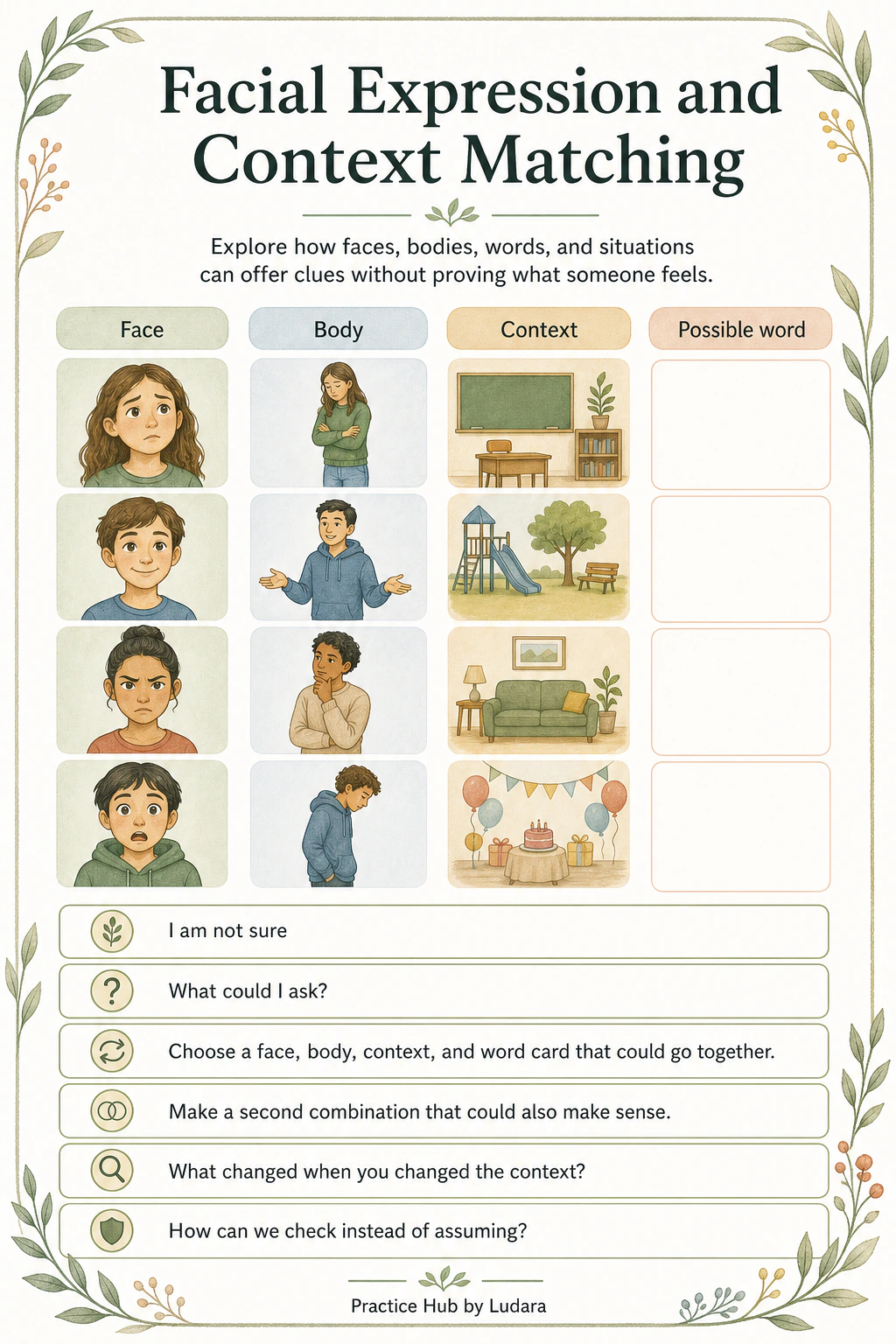
Facial Expression and Context Matching
Explore how faces, bodies, words, and situations can offer clues without proving what someone feels.
Clinical review required Ages 5-10
 10-20 minutes
 Cards
Cards Complete page
 View collection
Full-resolution WebP artwork with print-safe margins. Review the guidance below before use.
How to use it
- Choose a face, body, context, and word card that could go together.
- Make a second combination that could also make sense.
- Add an ‘I am not sure’ option or a question someone could ask.

Reflection prompts
- What changed when you changed the context?
- How can we check instead of assuming?

Facilitator guidance
Present every match as a hypothesis. Explain that expressions vary across people, cultures, disabilities, situations, and efforts to conceal or regulate emotion; do not train imitation of a preferred expression.

Adaptations & accessibility
- Use fewer card types or match only context and possible words.
- Include participant-created cards and neutral-expression cards.
- Allow pointing, sorting, AAC, or collaborative matching.

Review considerations
Licensed-clinician, cultural-responsiveness, and neurodiversity-informed review required before use; facial expressions must never be presented as proof of emotion or intent.
This is a layout-complete draft. Complete the stated clinical, accessibility, and local-policy review before client use or publication.