Trauma-Informed Resources · TI-08
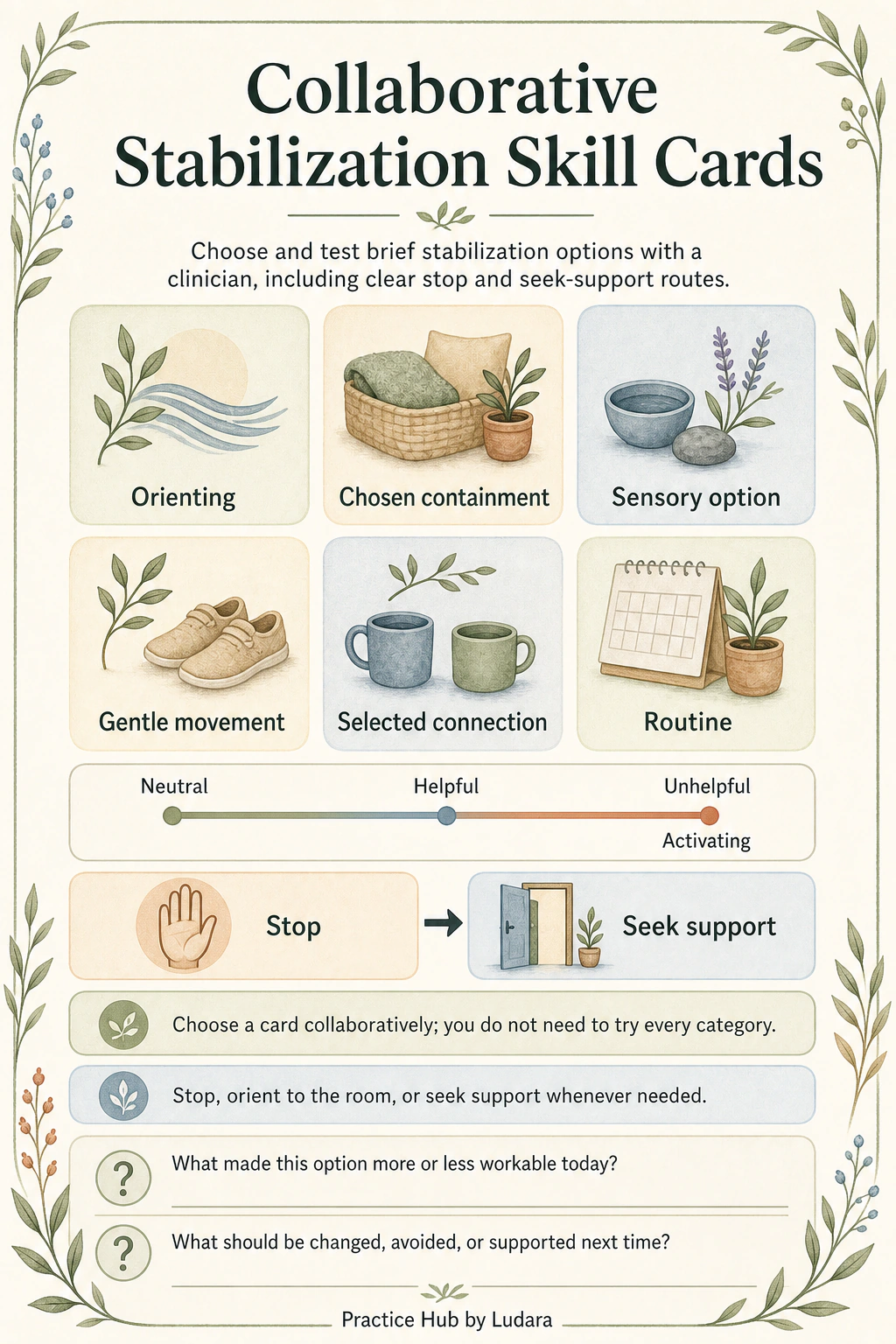
Collaborative Stabilization Skill Cards
Choose and test brief stabilization options with a clinician, including clear stop and seek-support routes.
Specialist review required Clinician-led trauma treatment; teens and adults
 2-15 minutes
 Guided worksheet
 Complete page
 View collection
Full-resolution WebP artwork with print-safe margins. Review the guidance below before use.
How to use it
- Choose a card collaboratively; you do not need to try every category.
- Agree on a stop signal and try the option for a short, adjustable time.
- Notice whether it feels neutral, helpful, unhelpful, or activating without judging the response.
- Stop, orient to the room, or seek support whenever needed.

Reflection prompts
- What made this option more or less workable today?
- What should be changed, avoided, or supported next time?

Facilitator guidance
Select skills from an individualized formulation and current assessment rather than assigning a standard sequence. Avoid surprise, performance pressure, breath reliance, intense body focus, or unsupervised use when the participant needs more support.

Adaptations & accessibility
- Change duration, posture, sensory channel, proximity, or environment.
- Use only external orienting and routine cards.
- Create personalized cards with explicit stop and support instructions.

Review considerations
Enhanced licensed trauma-specialist review required before use. Cards must be assigned collaboratively and are not a substitute for individualized assessment, treatment, or urgent support.
This is a layout-complete draft. Complete the stated clinical, accessibility, and local-policy review before client use or publication.