Play Therapy · PT-03
Puppets and Character Cutouts
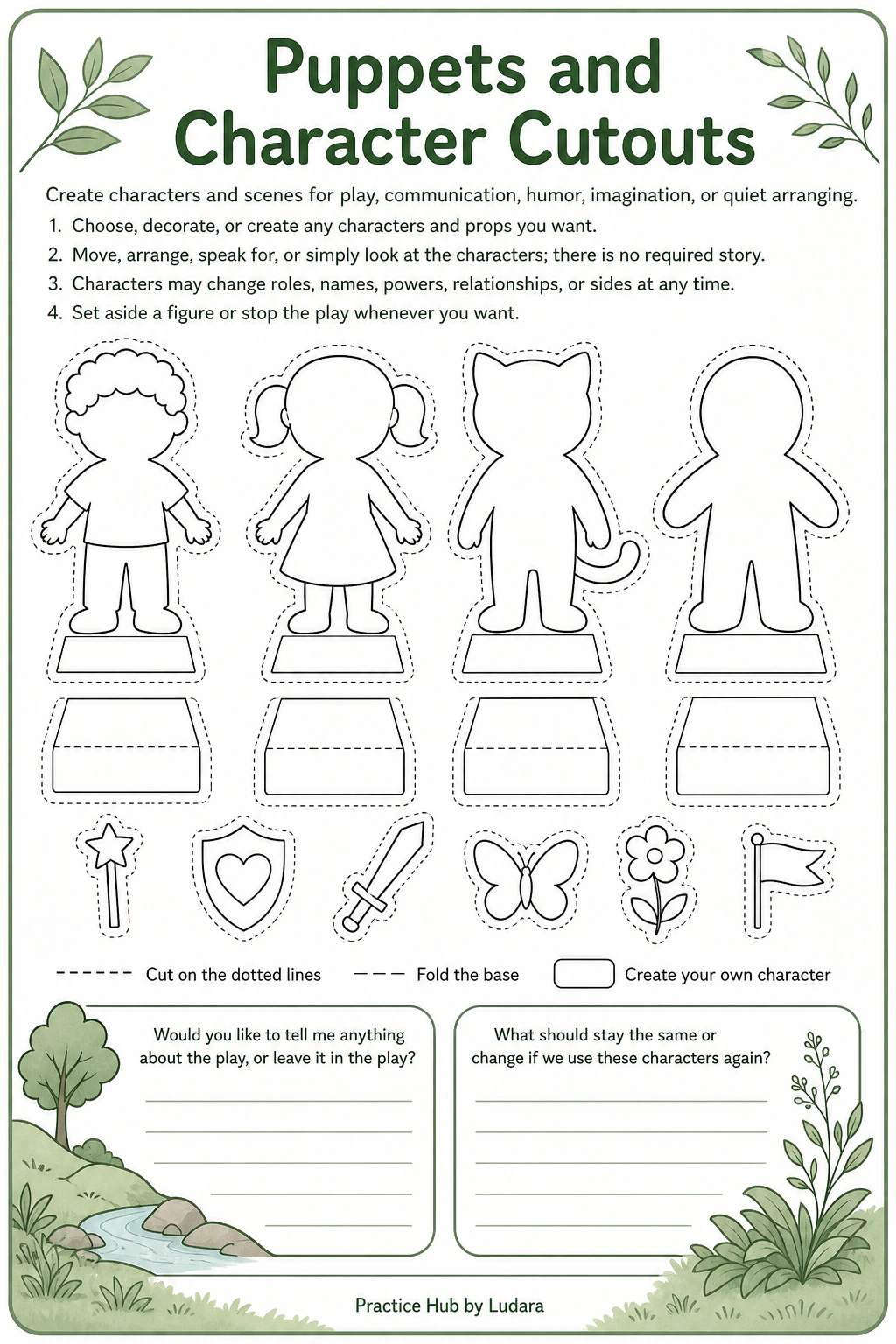
Create characters and scenes for play, communication, humor, imagination, or quiet arranging.
Specialist review required Ages 4-10 with adult supervision
 10-30 minutes
 Cards
Cards Complete page
 View collection
Full-resolution WebP artwork with print-safe margins. Review the guidance below before use.
How to use it
- Choose, decorate, or create any characters and props you want.
- Move, arrange, speak for, or simply look at the characters; there is no required story.
- Characters may change roles, names, powers, relationships, or sides at any time.
- Set aside a figure or stop the play whenever you want.

Reflection prompts
- Would you like to tell me anything about the play, or leave it in the play?
- What should stay the same or change if we use these characters again?

Facilitator guidance
Maintain a nondirective stance unless structure is clinically indicated and consented to. Avoid fixed villain, victim, rescuer, family, or diagnostic roles, and do not infer lived events from enactment alone; use ordinary safeguarding assessment when concerns arise.

Adaptations & accessibility
- Use preassembled figures, magnetic pieces, larger handles, or tabletop stands.
- Offer blank, nonhuman, fantasy, mobility-aid, and ambiguous-role figures.
- Permit parallel play, silent arranging, or clinician-assisted movement.

Review considerations
Licensed play-therapy and safeguarding review required before use. Assess choking, cutting, sharp-edge, material, and supervision safety for the child's age and abilities; do not treat symbolic enactment alone as disclosure.
This is a layout-complete draft. Complete the stated clinical, accessibility, and local-policy review before client use or publication.